
Whilst most people will be deciding which chocolate egg to consume this Easter we decided to take a more seasonal approach to Spring dining. And the result, a rather unusual and delicious savoury/sweet shortbread. Thinking you’d probably rather stick to a chocolate egg? I promise you that you will be amazed at how good this shortbread is. Perfectly paired with a cup of tea or as a sweet biscuit with cheese it was inspired by one of our food heroes, Carlo Petrini.
We recently had a visit in Scotland from Carlo, the founder of Slow Food which encouraged us once again to look at ways of using products which have made it onto the Slow Food’s ‘Ark of Taste’; a collection of British heritage products which face extinction. A ‘use it or lose it’ type of list. On that list are three products that have been incorporated into this recipe.
Firstly, beremeal, an all but forgotten flour which gives the biscuit a lovely nutty taste. Beremeal, is a variety of barley that is still milled today in Orkney (as well as Shetland and Sutherland). The Orkney isles are an archipelago of 70 islands positioned in the northern tip of Scotland, where the North Sea meets the Atlantic Ocean. Beremeal has been grown and ground there since Stone Age times where it is simply known as ‘corn’.
Beremeal, a variety of barley. Grown and milled in Orkney.
On the islands, of which only twenty are inhabited, there is a close community spirit and some incredible artisanal food and drink. At present this isn’t an island that we visit on any of our food tours, but with daily flights it is a destination we are investigating at present. Although a little remote (and it seems there is way too much to do for a food and whisky day tour), a short break or vacation may just be the ticket for when you really want to get away from it all and embrace the skills of local Scottish cuisine. Naturally no tour of Orkney would be complete without a little something to wash down the delicious food offerings. Fortunately with two whisky distilleries (Highland Park and Scapa) and a number of craft beer producers there is something to suit all tastes. If you would like to incorporate Orkney into your trip to Scotland at present, allow us to create one of our Platinum bespoke food and drink tours, which is individually designed to your timeframe, budget and particular interests. To get the flavour of orkney view this video: A Taste of Orkney’s Food & Drink
Continuing on to Dulse, the second ‘Ark of Taste’ product. Dulse, a wild seaweed with deliciously dark red-purple fronds.
The deep-red/purple coloured fronds of Dulse cultivated by ‘Mara Seaweed’.
Mara Seaweed in Scotland produce a fantastic range of dried seaweed. It is a product that is gaining huge popularity as a multi-purpose ingredient.
With super healthy nutritional benefits it would have been part of the regular diet of coastal dwellers. It can be used in savoury cooking to enhance the flavour, as a natural replacement for salt and can also act as a thickener for stews and the like. It has that can’t quite put your finger on it ‘umami’ quality.
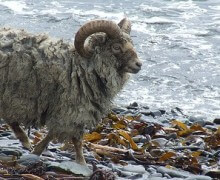
And finally to our third product. Always being inspired by the way the terroir of Scotland’s regions manifests through food, this recipe gives a nod (simply via the inclusion of fresh rosemary) to another at risk food, North Ronaldsay sheep. Reared on North Ronaldsay, the northernmost inhabited island, the sheep freely forage on the seaweed along the coastline. This produces something rather special by way of tenderness and flavour in the lamb or mutton and like this shortbread it is well worthy of a try!
Seaweed eating North Ronaldsay Sheep.
So, here it is ‘North Ronaldsay inspired Shortbread’. Pop your apron on, share the recipe as you like and tell us what you think. To all friends and prospective future friends of Tasting Scotland, we’d like to wish you a very Happy Easter.